2026.08.21
On August 19, Moderna and Merck announced topline results from the Phase III INTerpath-001 study of V940 (intismeran autogene). The study enrolled 1,137 patients with completely resected high-risk Stage IIB-IV melanoma. Compared with Keytruda alone, the combination of V940 and Keytruda met its primary endpoint of recurrence‑free survival (RFS) and the key secondary endpoint of distant metastasis‑free survival (DMFS).
The companies noted this is the first positive Phase III result for an individualized neoantigen therapy and the first positive Phase III result for an mRNA oncology therapeutic. Following the announcement, Moderna's share price rose sharply.
For the capital markets, this represents a significant breakthrough for Moderna's oncology business. For the broader mRNA industry, however, this is more than a single product success; it signals the expansion of mRNA technology from infectious disease vaccines into oncology and individualized medicine.
The core logic of V940 is straightforward: obtain patient tumor tissue, identify tumor‑specific mutations through sequencing, select immunogenic neoantigens, design patient‑specific mRNA sequences, and manufacture personalized vaccines.
However, the real market potential of PCV does not depend solely on V940 becoming a melanoma product, but rather on whether this technology can be replicated across other solid tumors.
Moderna and Merck have already built a broad clinical development matrix around V940, covering melanoma, non‑small cell lung cancer (NSCLC), renal cell carcinoma, bladder cancer, and others, with ongoing expansion into different treatment settings.
Meanwhile, BioNTech and Genentech are advancing their personalized mRNA neoantigen therapy autogene cevumeran (BNT122/RO7198457) in solid tumors including colorectal cancer. An increasing number of domestic Chinese companies are also entering the space.
Therefore, PCV is no longer a single company's isolated innovation. It is becoming a distinct technology field.
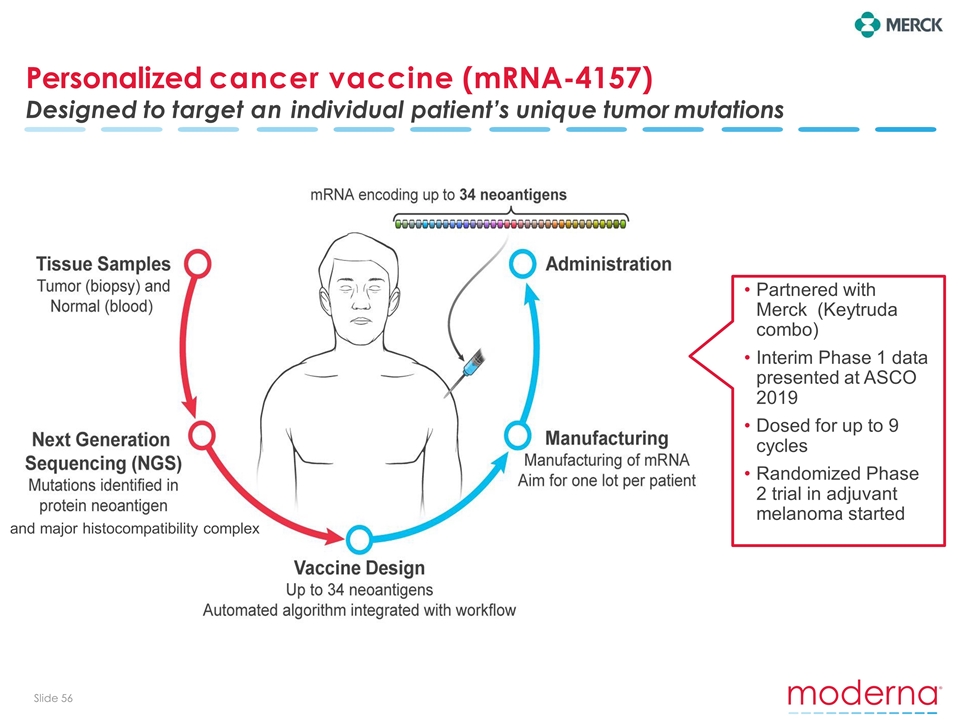
Source:Moderna
Recommended reading:mRNA Personalized Cancer Vaccines Have Arrived at Clinical Validation
As sequencing, AI‑driven neoantigen prediction, mRNA synthesis, LNP delivery, and quality control technologies advance, standardized platforms combined with individualized products are poised to support PCV expansion across multiple cancer types. This requires an end‑to‑end industrial system covering sample collection, sequencing, sequence design, mRNA manufacturing, formulation, quality control, and final delivery, which is an area where CDMO value becomes increasingly apparent. However, this also imposes entirely new demands on CDMOs:
• How to shorten individualized mRNA production timelines?
• How to achieve small-batch manufacturing for one-patient-at-a-time?
• How to ensure identity and quality for each patient's product?
• How to establish end‑to‑end traceability from patient sample to sequence, batch, and final product?
• How to achieve stable, reproducible manufacturing under GMP?
• How to further reduce manufacturing costs for individualized products?
Therefore, the next phase of PCV commercialization will be contested not only in the clinic, but also on the manufacturing floor.
Unlike conventional large‑scale mRNA drug manufacturing, PCV demands small batch sizes, rapid turnaround, and cost containment. To meet these requirements, Enorna has established a dedicated PCV production area and built an integrated platform covering plasmid, mRNA, and LNP manufacturing.
• Dedicated manufacturing facility: A PCV‑dedicated production center ensures isolated manufacturing space to prevent cross‑contamination.
• Customized small‑scale equipment: Customized TFF and encapsulation systems matched to single‑patient batch volumes, with controlled costs.
• Contamination prevention: Single‑use consumables and tubing to eliminate cross‑contamination risks.
• Rapid turnaround: PCV‑tailored manufacturing and release strategies to maintain quality and compliance while shortening production cycles.
• Chain of Identity / Chain of Custody (COI/COC): End‑to‑end traceability for individualized products to prevent mix‑ups or batch errors.
Enorna's PCV‑dedicated development strategy enables faster, more targeted, and more cost‑effective mRNA PCV manufacturing, accelerating clinical translation and bringing the promise of precision medicine to more patients.
Moderna's Phase III success may be just the beginning. The next decade of PCV will belong not only to clinical innovation, but also to manufacturing innovation. As the idea of “One-patient-at-a-time” transitions from concept to real industrial demand, those who can build flexible, efficient, compliant, traceable, and cost‑controlled manufacturing systems will become key players in the PCV industrialization journey.
Reach Out Today
Contact us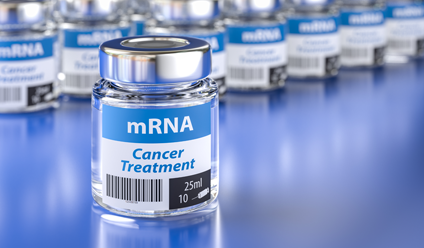
If 2023 was the year mRNA cancer vaccines rekindled hope, then 2026 is the year that hope has been repeatedly reinforced by clinical data.

EPI-003, has received Investigational New Drug (IND) clearance from the U.S. Food and Drug Administration (FDA) for the treatment of chronic hepatitis B (CHB).

On August 19, Moderna and Merck announced topline results from the Phase III INTerpath-001 study of V940 (intismeran autogene). The study enrolled 1,137 patients with completely resected high-risk Stage IIB-IV melanoma. Compared with Keytruda alone, the combination of V940 and Keytruda met its primary endpoint of recurrence‑free survival (RFS) and the key secondary endpoint of distant metastasis‑free survival (DMFS).

Tel. +86 18961517608
E-mail. bd@enorna.com
Address.
63 Keji Avenue,
Bldg. 6, Fl. 6,
Yixing, Jiangsu, China