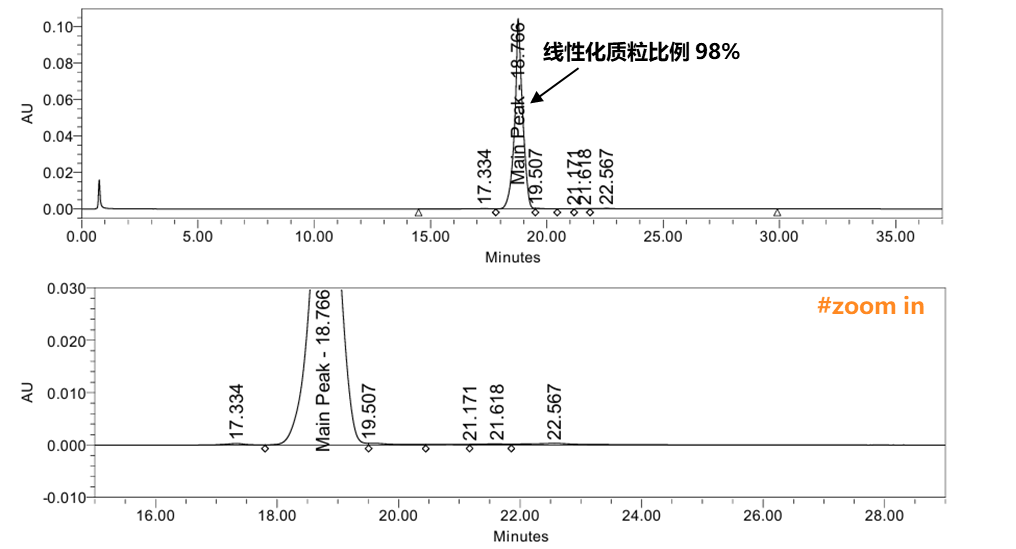

Enorna provides ready-to-use mRNA and LNP products designed for efficient transfection in mammalian cells and for supporting both in vitro and in vivo functional studies. Our RUO (Research Use Only) products ensure high batch-to-batch consistency and robust expression, helping to accelerate early research and streamline the path toward clinical translation.
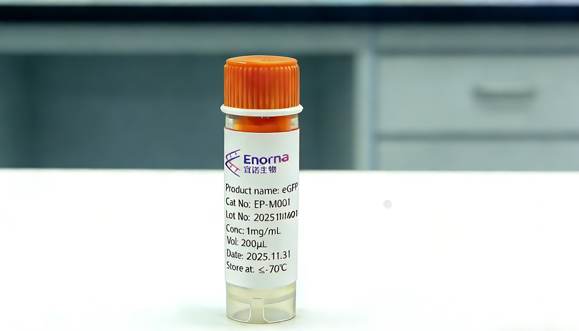
This mRNA encodes Enhanced Green Fluorescent Protein (eGFP), derived from Aequorea victoria. As a widely used fluorescent reporter, it emits bright green fluorescence with an excitation peak at 488 nm and an emission peak at 509 nm.
The mRNA is capped with a high-efficiency Cap 1 structure and features complete uridine substitution with N1‑methylpseudouridine (m1Ψ) to enhance expression and reduce immunogenicity. A poly(A) tail is included to support mRNA stability and translation efficiency.
EP-M001-0.2 200 μg
EP-M001-1 1 mg
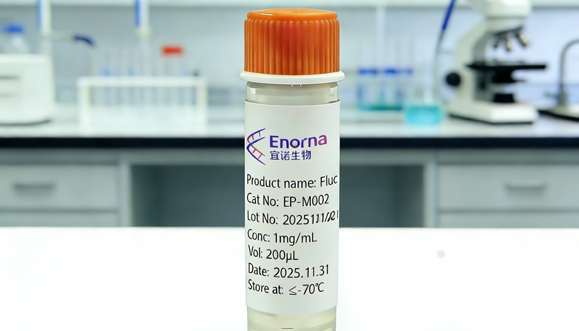
This mRNA encodes firefly luciferase (FLuc), originally derived from Photinus pyralis. FLuc is widely used in mammalian cell culture to monitor gene expression and cell viability. Upon delivery into cells or animal models, the expressed intracellular FLuc protein generates bioluminescence in the presence of its substrate, luciferin.
The mRNA features a Cap 1 structure for high capping efficiency and complete substitution of uridines with N1‑methylpseudouridine (m1Ψ), enhancing expression while reducing immunogenicity.
EP-M002-0.2 200 μg
EP-M002-1 1 mg

This mRNA encodes a CD19‑targeting construct for applications in CAR‑T cell therapy, immuno‑oncology research, and B‑cell‑related functional genomics. It is suitable for transfection in mammalian cells and in vivo expression studies.
The mRNA is capped with a Cap 1 structure to ensure high capping efficiency, and all uridines are fully modified with N1‑methylpseudouridine (m1Ψ) to enhance protein expression and minimize immunogenicity.
EP-M003-0.2 200 μg
EP-M003-1 1 mg
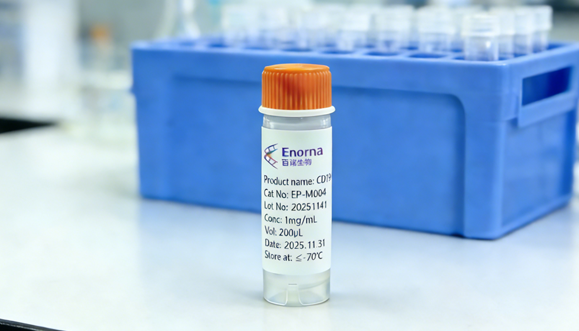
This product is a bispecific mRNA targeting both CD19 and CD20 antigens. It is designed for use in bispecific CAR‑T therapy development, mechanistic studies of B‑cell malignancies, and immune‑target synergy research, and is suitable for transfection in mammalian cells and in vitro/in vivo functional assays.
The mRNA incorporates a Cap 1 structure for high capping efficiency and full uridine modification with N1‑methylpseudouridine (m1Ψ). It enables co‑expression of both targets, improving B‑cell recognition while maintaining low immunogenicity.
EP-M004-0.2 200 μg
EP-M004-1 1 mg
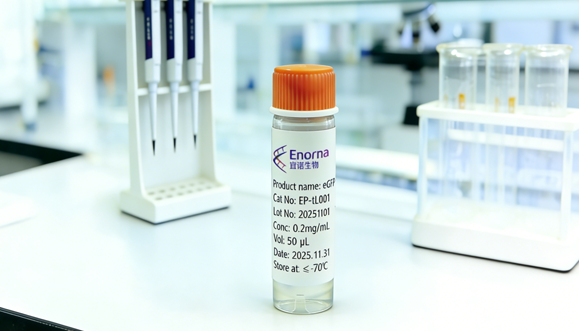
This is a targeted lipid nanoparticle (tLNP) formulation designed for CD8+ T cells, encapsulating mRNA encoding enhanced green fluorescent protein (eGFP)—a commonly used fluorescent reporter with excitation/emission peaks at 488 nm/509 nm.
The mRNA is fully modified with N1‑methylpseudouridine (m1Ψ) to enhance expression and reduce immunogenicity. The tLNP system uses SM‑102 as the ionizable lipid and displays surface‑conjugated anti‑human CD8 monoclonal antibody (murine) for specific delivery to CD8+ T cells.
This ready‑to‑use tool supports T‑cell functional studies, targeted delivery system development, and in vitro/vivo transfection validation, facilitating cell therapy and immunology research.
EP-tL001 0.05 mg
Purified mRNA drug substance is mixed with lipid components via microfluidic technology to form lipid nanoparticles (LNPs). The product then undergoes buffer exchange via ultrafiltration, sterile filtration, and vial filling. The formulation contains sucrose, lipid complex, and Tris-HCl. The lipid complex consists of an ionizable cationic lipid (e.g., SM-102), cholesterol, DSPC, and PEG2K.
We utilize an optimized IVT process with a low-dsRNA generation strategy to directly reduce dsRNA formation, followed by further removal through downstream purification steps. This significantly lowers dsRNA residual and reduces non-specific immune stimulation in cells and animals.
Yes, all our off-the-shelf products undergo stringent purification. We employ rigorous industrial-scale purification processes to ensure high purity and quality. After IVT, impurities are removed and the buffer is exchanged via tangential flow filtration (TFF) and Oligo dT chromatography, followed by sterile filtration and fill-finish.
The Poly(A) sequence is encoded directly downstream of the coding sequence in the DNA template, without any linker sequence, to enhance mRNA stability and translational efficiency. A tail shorter than 100 nt may lead to degradation, while an excessively long tail could trigger immune responses or reduce efficiency; therefore, our standard length is ≥100 nt.
Integrity is assessed and quantified using automated capillary electrophoresis. The results are included in the batch-specific Report of Analysis (RoA).
We perform a strict QC release panel including RNA length, content, purity, pH, and endotoxin levels. Each batch is accompanied by a detailed Report of Analysis (RoA).
Although designed for research use, our manufacturing process strictly controls endotoxin levels. Each batch is released following testing by the pharmacopeial gel-clot (semi-quantitative) method, with endotoxin content <10 EU/mg, suitable for various non-clinical in vitro and in vivo studies.
Yes. Our optimized and validated capping process consistently achieves >90% capping efficiency. Each batch is tested for capping rate using the industry-standard LC-MS method recommended by pharmacopoeias and guidelines. Specific results are available in the corresponding RoA.
Our mRNA products are typically capped co-transcriptionally by including a trinucleotide cap analog directly in the IVT reaction mix. This one-step process yields a highly efficient, low-immunogenicity Cap 1 structure, a key factor in product safety and efficacy.
The co-stimulatory domain sequences in Enorna's CD19 CAR mRNA and CD19 & CD20 CAR mRNA products are optimized for T cell function and are recommended for T cell transfection. Published studies also indicate that similar structures can be used for in vivo CAR-NK development, making these products suitable for NK cell transfection research as well.
Please refer to the product-specific technical data sheet or product insert. You can also download technical documents from the relevant product page on our website at www.enorna.com. For further details, please contact our Sales or Technical Support team at bd@enorna.com.
The CD19 scFv is derived from the murine monoclonal antibody FMC63 against human CD19. The CD20 scFv is derived from the murine monoclonal antibody Leu-16 against human CD20.
The LNP surface is covalently conjugated with a murine anti-human CD8 monoclonal IgG antibody, which specifically recognizes human CD8+ T cells.
To protect intellectual property and technical confidentiality, we are unable to provide the original DNA template sequences used for mRNA production. We ensure all mRNA products undergo strict quality control and technical validation and provide detailed product specifications to support your research.
After order confirmation, we arrange shipment within 3 business days. Under normal logistics conditions, products are expected to arrive within 3 business days after dispatch (excluding remote areas and non-standard shipping methods).
Thank you for your interest. Enorna currently does not offer large-scale packaging for standard off-the-shelf products but can provide custom manufacturing services to meet large-scale needs. Standard off-the-shelf items are readily available for quick delivery, while lead times for custom orders depend on specific scale and process requirements.
To ensure product quality and usability, we guarantee a remaining shelf life of at least 6 months upon shipment. Specific manufacturing dates and expiry information can be found on the accompanying Report of Analysis (RoA) and product label. Products must be stored at ≤ -70°C.
Yes, in addition to off-the-shelf products, Enorna offers full-sequence custom mRNA synthesis and LNP encapsulation services. You can specify the sequence, modifications, capping method, lipid formulation, etc., based on your research needs. Please contact our Sales or Technical Support team at bd@enorna.com for details.
Products are packed with sufficient dry ice and shipped via passive temperature-controlled transport, maintaining appropriate temperatures throughout transit. This ensures stability for up to 3 days under standard shipping distances. Specific temperature specifications are detailed in the Report of Analysis (RoA).
mRNA products should be stored at ≤ -70°C, avoiding repeated freeze-thaw cycles. Under these conditions, products can remain stable for up to 2 years from the date of manufacture.
To avoid stability issues from repeated freeze-thaw cycles, it is highly recommended to aliquot the product upon first receipt according to single-use volumes. Unused aliquots should always be stored at ≤ -70°C.

Tel. +86 18961517608
E-mail. bd@enorna.com
Address.
Fl. 6, Bldg. 6,
63 Keji Avenue,
Yixing, Jiangsu, China