
mRNA-tLNP-based in vivo CAR therapy eliminates the risk of genomic integration, offering a superior safety profile. By conjugating different antibodies onto the tLNP surface, CAR genes can be precisely delivered to targeted T cell subsets, enabling more accurate in vivo CAR-T cell generation.
Enorna provides end-to-end in vivo CAR solutions starting from sequences, including plasmid, mRNA, tLNP, and analytics, to accelerate the clinical translation of in vivo CAR therapeutics and bring benefits to patients sooner.
Enorna offers comprehensive CMC and GMP manufacturing services for mRNA-tLNP-based in vivo CAR therapies, supporting process development starting from sequences, preclinical sample production, global regulatory submissions, GMP manufacturing at various clinical stages, and commercial-scale production.


Lab-Scale Process Development
Rapid IIT Sample Production

CMC Development
Plasmid-mRNA-LNP-Antibody Conjugation Process Development
Analytical Method Development and Validation
IND Submission and Regulatory Support

GMP-Grade Plasmid and mRNA Drug Substance Manufacturing
GMP-Grade LNP Manufacturing and Antibody Conjugation
Aseptic Fill-Finish
Commercial-Scale Batch Production
For any stage of your project, please contact us for inquiries.
Contact us

Antibody

Antibody Reduction

Antibody Purification

Plasmid

mRNA Drug Substance

LNP Encapsulation

Antibody Conjugation

Release Testing

Aseptic Fill-Finish

Sterile Filtration
Purification
Experience in developing 25+ novel cationic lipid formulations
Offering a diverse library of lipids for targeting various organs/cells
Novel PEG solutions to avoid the generation of anti-PEG antibodies
Robust conjugation processes ensure product homogeneity and process controllability
>90% conjugation efficiency ensures targeted in vivo delivery
Robust gram-scale scale-up processes
Experience in conjugating various antibody formats, including IgG, VHH, scFv, Fab, and others
In-house NanoFCM platform for conjugation efficiency, copy number, and empty rate analysis
Antibody Functional Activity Testing
Process-Related Impurity Analysis (e.g., adducts, lipid impurities)
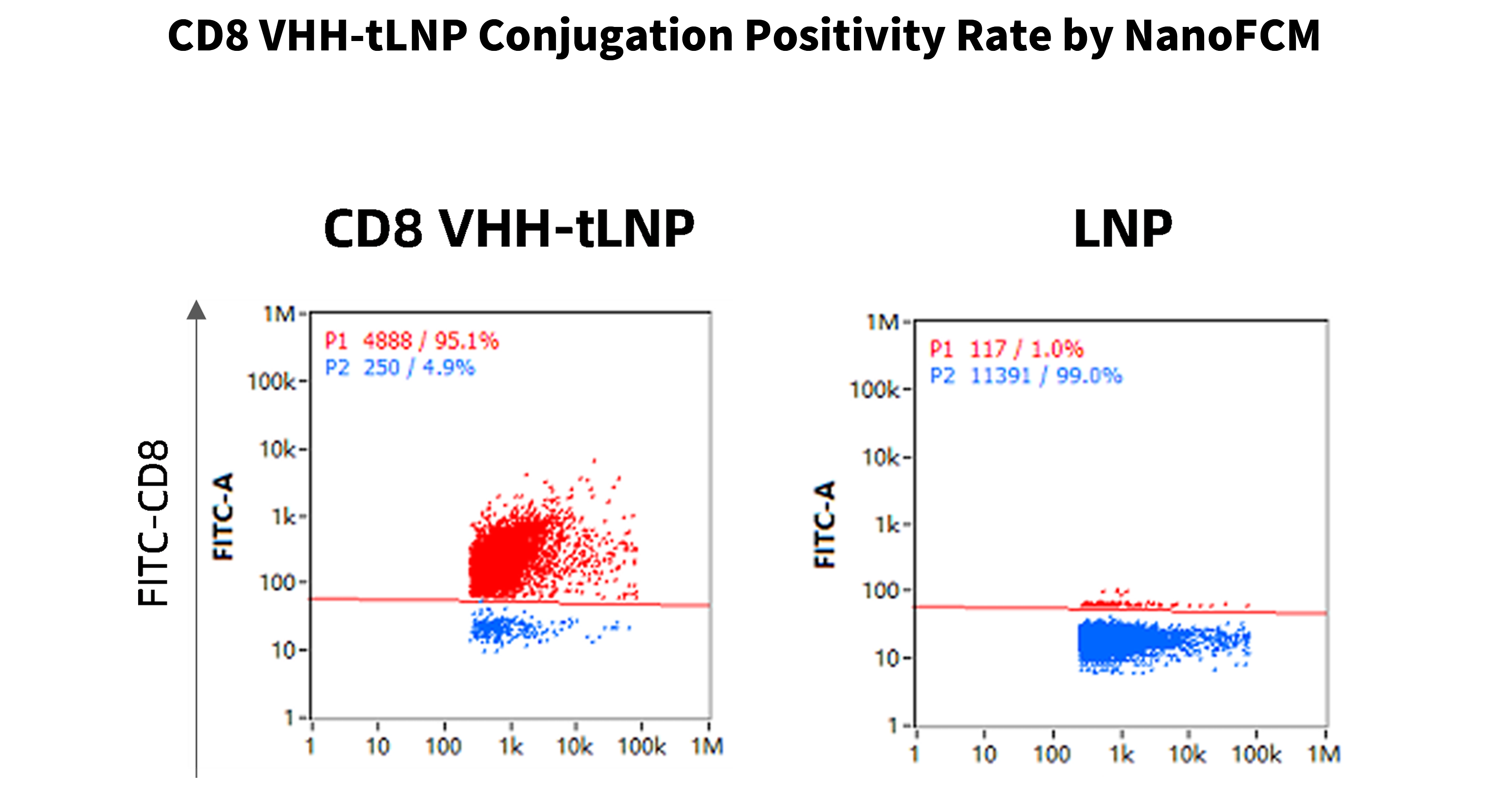
After conjugating CD8 VHH antibodies onto LNPs formulated with novel lipids, the conjugation positivity rate on the LNP surface was analyzed using nanoFCM.
As shown in the results, the FITC-positive population (red particle cluster) representing CD8 VHH-conjugated LNPs accounted for 95.1%.
Enorna has expertise in antibody conjugation process optimization, consistently achieving >90% antibody conjugation efficiency.
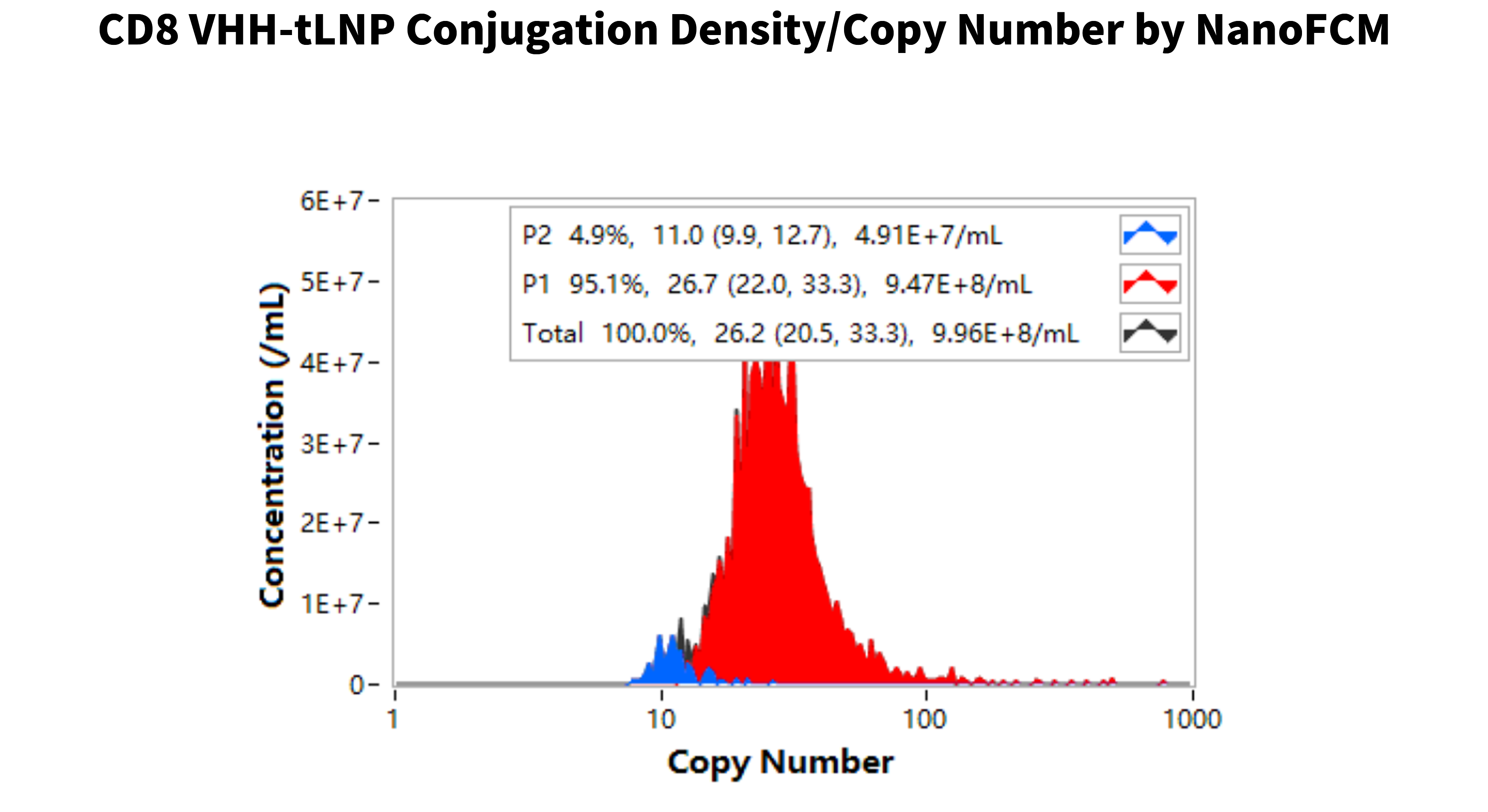
After antibody conjugation, the density of antibodies on the LNP surface (i.e., the antibody conjugation copy number) is analyzed using nanoFCM.
As shown in the results, the red peak represents the antibody-positive population. The average copy number per LNP can be calculated based on a fluorescence standard curve.
Copy number is critical to targeted delivery efficiency. Enorna's strong process development team enables precise tuning of antibody conjugation density to ensure therapeutic efficacy.

If not properly controlled, the antibody conjugation process can lead to increased particle size, elevated polydispersity index (PDI), and decreased encapsulation efficiency, thereby compromising targeting efficiency and altering biodistribution.
We have systematically optimized multiple critical parameters in the conjugation process to minimize physicochemical impact on LNP particles, ensuring that particle size, PDI, and encapsulation efficiency remain highly consistent before and after conjugation across different antibodies, thereby safeguarding the in vivo efficacy of tLNP drug products.
Reach Out Today
Contact us
Tel. +86 18961517608
E-mail. bd@enorna.com
Address.
Fl. 6, Bldg. 6,
63 Keji Avenue,
Yixing, Jiangsu, China